
Latex vs PU vs Silicone Artificial Flowers
Compare latex, PU, and silicone finishes for artificial flower wholesale sourcing, with buyer guidance on pricing, use cases, and RFQ specs.
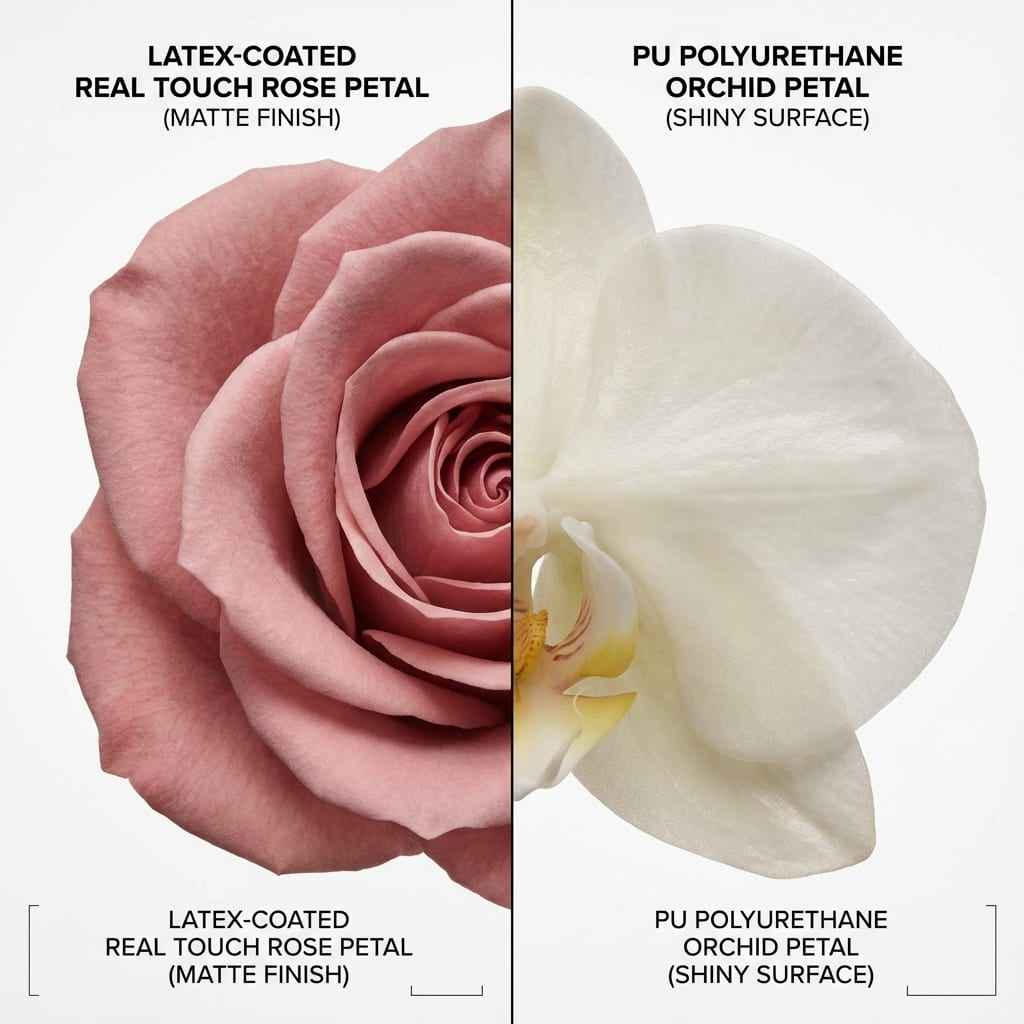
Understanding Artificial Flower Materials: Why It Matters for Wholesale
When sourcing real touch artificial flowers wholesale, material selection directly impacts your product positioning, customer satisfaction, and profit margins. The three primary coating materials—latex, PU (polyurethane), and silicone—each offer distinct advantages for different applications.
This guide helps wholesale buyers, importers, and brand owners understand these differences to make informed sourcing decisions.
Key Takeaways
- Latex coating delivers the most realistic hand-feel at competitive pricing
- PU (polyurethane) offers enhanced durability for commercial installations
- Silicone finishes provide ultra-premium texture but at higher cost
- MOQ typically 500–576 pcs/style for Real Touch lines
- Sample evaluation (~15 days) is essential before bulk commitment
- FOB Xiamen with sea freight is standard for China-sourced orders
Material Comparison: Latex vs PU vs Silicone
Latex-Coated Artificial Flowers
Characteristics:
- Soft, slightly cool touch that mimics fresh petals
- Natural matte finish with subtle texture
- Excellent color depth through layered application
- Most popular for Real Touch roses, tulips, and peonies
Best Applications:
- Wedding and event decor (close-up photography)
- Premium retail florist programs
- Home decor collections targeting quality-conscious consumers
Wholesale Considerations:
- Balanced price-to-quality ratio
- Strong batch consistency from established manufacturers
- Standard MOQ: 500–576 pcs/style
PU (Polyurethane) Finishes
Characteristics:
- Slightly firmer texture than latex
- Enhanced durability and shape retention
- Better resistance to handling and environmental factors
- Often used for orchids, lilies, and commercial installations
Best Applications:
- Hotel lobbies and restaurant decor
- Corporate office installations
- Retail displays with frequent customer interaction
- Outdoor-adjacent applications (covered patios, atriums)
Wholesale Considerations:
- Marginally higher per-unit cost than latex
- Excellent for buyers prioritizing longevity over budget
- Same MOQ and lead time structure as latex options
Silicone-Enhanced Flowers
Characteristics:
- Ultra-soft, almost organic feel
- Premium gloss or matte finish options
- Highest realism for close inspection
- Less common in standard wholesale catalogs
Best Applications:
- Luxury boutique and designer collections
- Film and television production
- High-end hospitality projects
- Custom installations where budget is secondary
Wholesale Considerations:
- Often higher pricing (commonly 2–3x latex alternatives)
- May require custom production arrangements
- Worth sampling for premium market segments
How Material Choice Affects Your Sourcing Strategy
Pricing Implications
Material selection directly impacts FOB pricing. For budget planning:
- Latex: Baseline pricing for Real Touch quality
- PU: typically 10–20% premium over latex equivalents
- Silicone: can be 100–200% premium, often custom-quoted
MOQ and Production
Standard MOQ of 500–576 pcs/style applies across all material types for Real Touch lines. Custom silicone work may require higher minimums—confirm with your supplier during RFQ.
Quality Control Focus
Different materials require different QC attention:
- Latex: Check for coating consistency and color accuracy
- PU: Verify flexibility and durability under handling
- Silicone: Inspect for surface defects and finish uniformity
What to Include in Your Supplier RFQ
When requesting quotes for Real Touch flowers, specify:
- Target styles — Share product images or reference links
- Material preference — Latex, PU, or open to recommendation
- Quantity per style — Confirm against supplier’s MOQ
- Target market — Wedding, retail, commercial (helps supplier advise on finishes)
- Packing requirements — Standard or custom carton marking
- Destination port — For accurate freight estimation
Sampling Process: Verify Before You Commit
Avoid skipping the sample stage when sourcing new materials or suppliers:
- Sample lead time: ~15 days from order confirmation
- What to evaluate: Texture, color accuracy, petal drape, stem flexibility
- Comparison testing: Request both latex and PU versions of key styles
- Photography test: Shoot samples under your typical lighting conditions
Production and Shipping Timeline
Plan your sourcing calendar with these benchmarks:
- Samples: ~15 days
- Bulk production: 60–90 days after sample approval
- Sea freight: 3–4 weeks (FCL faster than LCL consolidation)
- Buffer: Add 2 weeks for customs and inland delivery
Standard Incoterms: FOB Xiamen
Payment: T/T, L/C, PayPal, bank transfer (30% deposit to initiate production)
B2B CTA: Get Material Samples
Compare materials before committing to bulk.
- Request samples — Specify styles and material preferences
- Check MOQ & Best-Seller List — Review curated Real Touch options
- WhatsApp — Quick consultation on material options
Trade Terms:
- MOQ: 500–576 pcs/style
- Samples: ~15 days
- Bulk: 60–90 days
- FOB Xiamen | Sea freight (FCL/LCL)
- T/T, L/C, PayPal | 30% deposit
Frequently Asked Questions
Which material is best for wedding flowers?
Latex is most popular for weddings due to its natural hand-feel and photography performance. PU works well for larger statement pieces.
Do PU flowers cost more than latex?
Yes, typically 10–20% higher. The premium reflects enhanced durability and production complexity.
Can I mix latex and PU in one order?
Absolutely. Many buyers order latex for close-up items (bouquets, centerpieces) and PU for installation pieces (arches, backdrops).
How do I know if a supplier uses quality latex?
Request samples and evaluate in person. Check for consistent coating, natural color gradients, and petal flexibility. Cheap latex feels rubbery or uneven.
Is silicone worth the extra cost?
For luxury or specialty applications, yes. For standard wholesale, latex or PU offers better ROI.
What’s the minimum order for silicone flowers?
This varies by supplier. Expect higher MOQs or custom production requirements compared to standard latex/PU lines.
Suggested Internal Links
- What Is Real Touch? — Material overview
- Real Touch Flowers Wholesale — Wholesale overview
- Browse Real Touch Orchids — View PU options
- About Our Capabilities — Manufacturing capabilities
- Contact for RFQ — Request material samples
- Wholesale Catalog — Full product range
Everbloom Florals is a dedicated B2B manufacturer and wholesaler of artificial flowers based in Xiamen, China. We operate as a factory-direct partner serving global wholesale buyers, retailers, and project clients. We do not operate retail florist services.
Ready to Source Real Touch Flowers?
MOQ 500–576 pcs/style · Samples ~15 days · Bulk 60–90 days · FOB Xiamen · Sea freight (FCL/LCL)
Wholesale sourcing pages mentioned in this guide
Real Touch flowers wholesale
Latex-coated artificial flowers for importers, distributors, wedding suppliers, and premium retail programs.
Silk flowers wholesale
Classic artificial silk flowers for cost-sensitive retail, event, and floral supply programs.
Wholesale artificial flower catalog
Browse wholesale artificial flower SKUs with MOQ guidance, samples around ~15 days, and FOB Xiamen terms.
Wholesale buyer MOQ guide
Plan sample requests, mixed-SKU orders, lead times, and quote details before placing a bulk order.