
Export Packing for Artificial Flowers
How manufacturers pack artificial flowers for sea freight, including carton standards, FCL vs LCL, damage prevention, and shipping marks.
Why Proper Packing Matters for Artificial Flower Wholesale
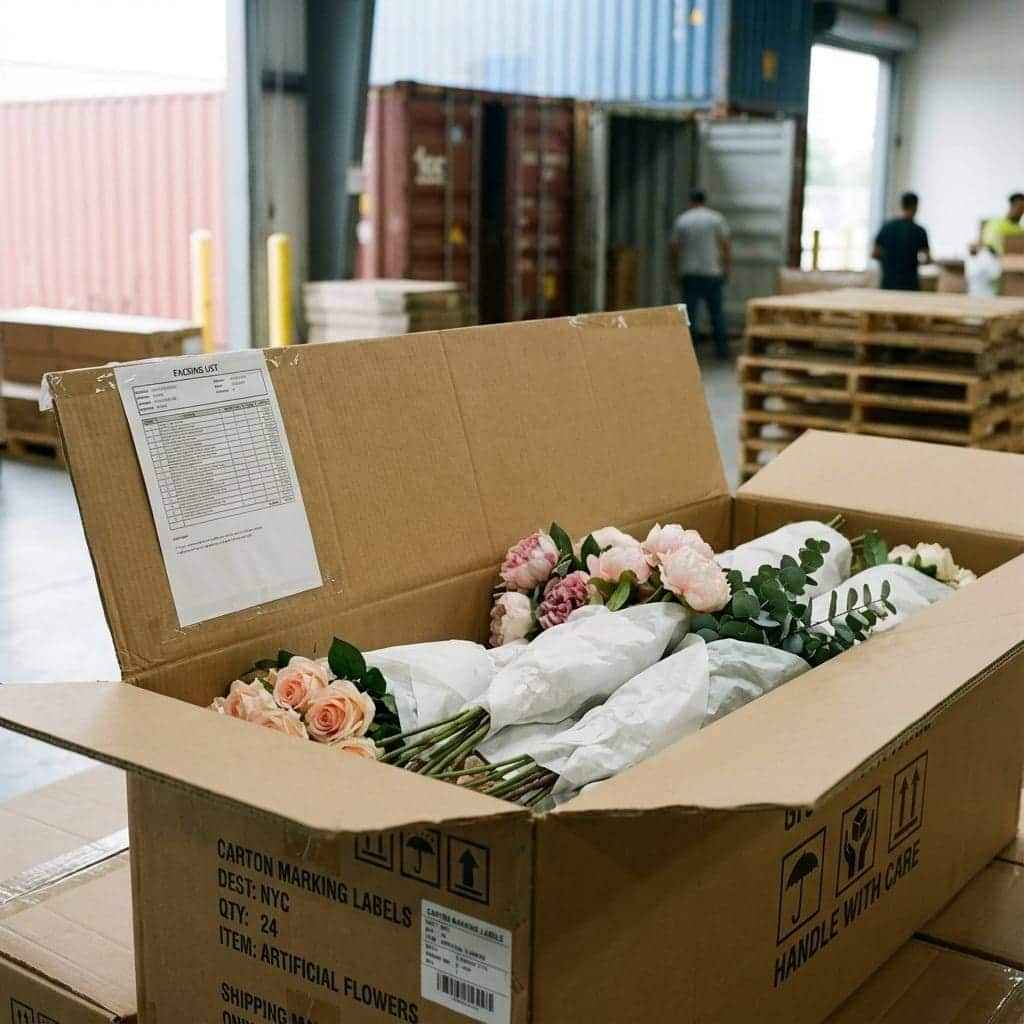
For buyers sourcing real touch artificial flowers wholesale, the journey from factory to warehouse involves weeks of transit, multiple handling points, and variable conditions. Professional export packing protects your investment and ensures products arrive in sellable condition.
This guide explains how experienced manufacturers prepare wholesale orders for sea freight, what documentation to expect, and how to communicate your packing requirements effectively.
Key Takeaways
- Inner packing protects individual items; carton packing optimizes container loading
- Carton marking with shipping marks reduces receiving errors
- FCL (Full Container Load) offers better protection and lower per-CBM costs
- LCL consolidation suits smaller orders but involves more handling
- Standard terms: FOB Xiamen, sea freight, 60–90 day production timeline
- Request loading photos and packing lists before shipment
The Multi-Layer Packing System
Layer 1: Product-Level Protection
Each artificial flower receives individual protection based on fragility:
Real Touch Flowers:
- Tissue wrapping for delicate petals
- Foam sleeves for stem protection
- Separation layers to prevent color transfer
- Dust covers for light-colored items (whites, creams, pastels)
Greenery and Foliage:
- Bundling with protective bands
- Compression-resistant spacing
- Stem alignment for efficient box filling
Layer 2: Inner Box Configuration
Products are grouped into inner boxes for organization:
- Standard configuration: 24 pcs per inner box (varies by product size)
- Inner boxes are labeled with SKU, color code, and quantity
- Sizing minimizes movement during transit
- This is why MOQ 500–576 pcs/style aligns with efficient packing (24 × 24 = 576)
Layer 3: Master Carton Packing
Inner boxes are packed into export-grade master cartons:
- Double-wall corrugated cartons for international shipping
- Weight limits respected (typically 20–25 kg maximum)
- Corner reinforcement for stacking
- Compression testing for container loading conditions
Carton Marking: What Buyers Should Specify
Clear carton marking reduces warehouse receiving errors and speeds inventory processing.
Standard Marking Elements
Shipping Marks:
- Buyer logo or identifier
- PO or reference number
- Carton number (e.g., “1/50”)
Product Information:
- SKU or style code
- Quantity per carton
- Color specification
Handling Instructions:
- “Fragile” or “Handle With Care”
- “Keep Dry”
- “This Side Up” with arrow
How to Communicate Requirements
Include marking specifications in your RFQ:
- Provide artwork files for logos/marks
- Specify language requirements
- Note any retailer or warehouse scanning needs (barcodes)
FCL vs LCL: Choosing Your Shipping Mode
FCL (Full Container Load)
Best for: Orders filling 20’ or 40’ containers
Container Capacity:
- 20’ container: ~25–30 CBM / 8–10 tons
- 40’ container: ~55–60 CBM / 18–22 tons
Advantages:
- Lower per-CBM freight cost
- Faster customs clearance (single manifest)
- Less handling = lower damage risk
- Door-to-door container seal
Considerations:
- Higher minimum volume requirement
- Pay for full container regardless of fill
LCL (Less than Container Load)
Best for: Trial orders, smaller buyers, or mixed-supplier consolidation
Advantages:
- No minimum volume requirement
- Pay only for space used
- Flexible for testing new suppliers
Considerations:
- Higher per-CBM cost
- Multiple handling points (CFS loading/unloading)
- Longer transit time (consolidation delays)
- Higher damage risk from shared container
Damage Prevention Strategies
Reputable manufacturers implement systematic damage prevention:
Pre-Shipment Measures
- Compression testing — Cartons tested for stacking weight
- Moisture barriers — Silica gel packets during humid seasons
- Inner padding — Foam or paper fill for carton voids
- Stretch wrapping — Pallet stabilization for FCL orders
Loading Supervision
- Staff present during container loading
- Systematic stacking pattern (heavy items bottom, fragile top)
- Loading gap minimization
- Photo documentation at each stage
Documentation
- Loading photos provided upon request
- Container seal number recorded
- Packing list with carton-level detail
Export Documentation Package
Buyers should receive the following before or with shipment:
Commercial Documents:
- Commercial Invoice
- Packing List (carton-level detail)
- Bill of Lading or Airway Bill
Compliance Documents (as applicable):
- Certificate of Origin
- Phytosanitary Certificate (for certain markets)
- Fumigation Certificate (if required)
- Audit documentation (upon request)
Communicating Packing Requirements in Your RFQ
Include these specifications when requesting quotations:
PACKING REQUIREMENTS

Inner Box: Standard or specify configuration
Master Carton: Double-wall export grade
Max Weight: 20 kg per carton
Shipping Marks: [Provide artwork or text]
Labeling: SKU + quantity + color per carton
Documentation: Commercial Invoice, Packing List, CO
Special Instructions: [Any retailer or warehouse requirements]
Timeline: From Production to Delivery
| Stage | Timeline |
|---|---|
| Production | 60–90 days |
| Final QC & Packing | Included in production |
| Loading & Departure | 3–5 days |
| Sea Transit (Asia to US/EU) | 15–30 days |
| Customs & Delivery | 5–10 days |
| Total | 90–135 days from order |
Plan backwards from your selling season to determine order timing.
B2B CTA: Discuss Your Shipping Requirements
Planning a wholesale order? Let’s discuss packing and logistics.
- Request a quote — Include your destination and volume
- Check MOQ & Best-Seller List — Review curated lines and MOQ fit
- WhatsApp — Quick logistics questions
Trade Terms:
- MOQ: 500–576 pcs/style (Real Touch)
- Incoterms: FOB Xiamen
- Shipping: Sea freight (FCL/LCL)
- Payment: T/T, L/C, PayPal (30% deposit)
Frequently Asked Questions
What carton sizes do you use?
Carton dimensions vary by product. We optimize for container pallet loading. Dimensions are confirmed in PI (Proforma Invoice) documentation.
Can I request custom packing?
Yes. Custom inner box configurations, carton marking, and retail-ready packing are available. Discuss during RFQ to confirm pricing impact.
Do you provide loading photos?
Yes. Photos at key stages (pre-loading, during loading, container seal) are provided upon request at no additional charge.
What insurance should I arrange?
For FOB shipments, buyers arrange cargo insurance from loading port. We recommend coverage for CIF value plus 10%.
How do you handle damage claims?
Document damage immediately upon arrival with photos. We work with buyers to resolve through replacement, credit, or insurance claims depending on circumstances.
Can you ship to my freight forwarder?
Yes. Provide forwarder details and we coordinate loading and documentation.
Suggested Internal Links
- Sourcing Guide: RFQ Checklist
- Material Guide
- Real Touch Flowers Wholesale
- Artificial flowers wholesale product lines
- About Our Capabilities
- Submit wholesale RFQ
Everbloom Florals is a dedicated B2B manufacturer and wholesaler of artificial flowers based in Xiamen, China. We operate as a factory-direct partner serving global wholesale buyers, retailers, and project clients. We do not operate retail florist services.
Ready to Source Real Touch Flowers?
MOQ 500–576 pcs/style · Samples ~15 days · Bulk 60–90 days · FOB Xiamen · Sea freight (FCL/LCL)
Wholesale sourcing pages mentioned in this guide
Real Touch flowers wholesale
Latex-coated artificial flowers for importers, distributors, wedding suppliers, and premium retail programs.
Silk flowers wholesale
Classic artificial silk flowers for cost-sensitive retail, event, and floral supply programs.
Wholesale artificial flower catalog
Browse wholesale artificial flower SKUs with MOQ guidance, samples around ~15 days, and FOB Xiamen terms.
Wholesale buyer MOQ guide
Plan sample requests, mixed-SKU orders, lead times, and quote details before placing a bulk order.