
Artificial Flower Quality Control Guide
QC guide for artificial flower wholesale buyers, covering in-line inspection, batch consistency, pre-shipment checks, and supplier communication.
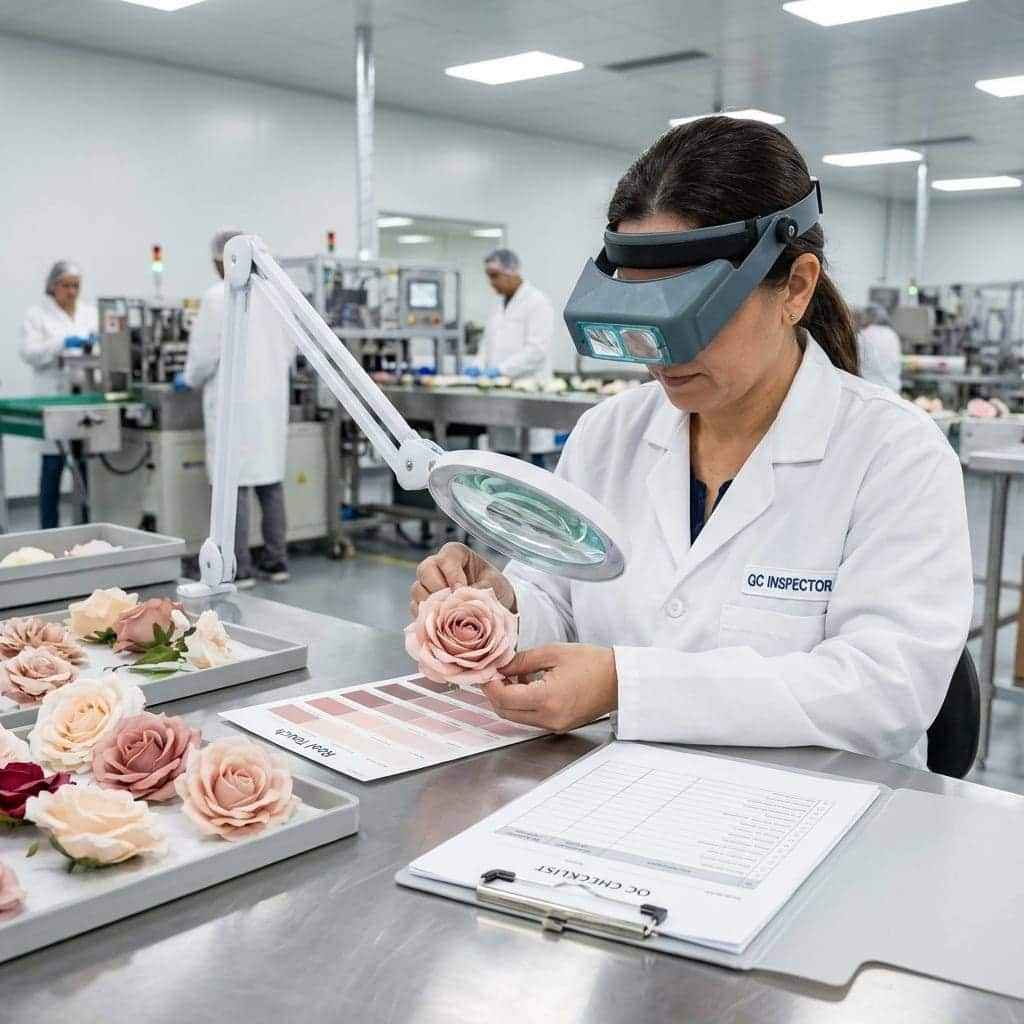
Direct Answer: Artificial Flower QC Should Start Before Production
Wholesale artificial flower quality control should cover five stages: incoming material inspection, first-article approval, in-line checks, final AQL-based inspection, and pre-shipment packing verification. Buyers reduce risk when QC requirements are written into the RFQ, confirmed in the purchase order, and checked against approved production samples.
For Real Touch flowers, QC should give special attention to color consistency, latex or PU coating feel, petal shape recovery after packing, stem strength, and carton compression.
Why Quality Control Matters for Wholesale Artificial Flower Buyers
When sourcing real touch artificial flowers wholesale, quality inconsistency is one of the biggest risks buyers face. Defects discovered after shipment create returns, customer complaints, and margin erosion that no business can afford.
Understanding how manufacturers implement quality control—and how to communicate your requirements—helps wholesale buyers minimize risk and build reliable supply chains.
Key Takeaways
- Quality control spans five stages from materials to shipping
- In-line checks catch issues before they compound
- Pre-shipment inspection is your last verification point
- Communicate specific quality standards in your RFQ
- Request QC photos and documentation before shipment
- Consider third-party inspection for large or new supplier orders
Wholesale QC Decision Table
| QC area | Buyer should require | Why it matters |
|---|---|---|
| Material | Latex, PU, fabric, wire, and color lot checks | Prevents defects that cannot be fixed after assembly |
| First article | Bulk standard sample, not special showroom sample | Creates a realistic benchmark for production |
| In-line inspection | Color, petal shape, attachment, coating, and stem checks | Catches problems before thousands of units are completed |
| Final inspection | AQL-based sampling plan and defect classification | Defines what passes, what fails, and what needs rework |
| Packing | Inner support, carton strength, carton mark, and SKU check | Reduces crushing, SKU mix-ups, and receiving disputes |
| Shipment release | QC photos, packing list, and loading photos for FCL | Gives buyers evidence before balance payment and shipment |
The Five Stages of Artificial Flower Quality Control
Stage 1: Incoming Material Inspection
Quality begins before production:
What’s Checked:
- Raw material quality (fabric, foam, wire, latex/PU coatings)
- Color consistency of base materials
- Material lot tracking for traceability
Why It Matters: Poor raw materials create defects that can’t be fixed later. Reputable manufacturers reject substandard inputs.
Stage 2: Production Setup Verification
Before mass production begins:
What’s Checked:
- First-article samples against approved standards
- Equipment calibration and tooling condition
- Worker training on style specifications
Why It Matters: Catching issues at setup prevents entire batches from failing.
Stage 3: In-Line Quality Checks
During production, spot-checks occur continuously:
What’s Checked:
- Color matching against master samples
- Petal formation and attachment
- Stem flexibility and structure
- Coating consistency (for Real Touch products)
Frequency: Random sampling every 2–4 hours depending on complexity.
Why It Matters: Early detection prevents defects from accumulating across thousands of units.
Stage 4: Final Inspection (Pre-Packing)
Before products enter cartons:
What’s Checked:
- Visual inspection of finished products
- Functional testing (stem flexibility, petal attachment)
- Dimensional verification
- Cleaning and presentation
Sampling Rate: Industry standard: AQL (Acceptable Quality Level) sampling. For general wholesale orders, an AQL reference such as 2.5 for major defects can be discussed; critical defects should have stricter acceptance rules agreed in writing.
Why It Matters: Last opportunity to catch defects before packing makes inspection difficult.
Stage 5: Pre-Shipment QC and Documentation
Before containers are loaded:
What’s Checked:
- Carton condition and sealing
- Packing list accuracy (SKU, quantity, carton number)
- Shipping mark verification
- Documentation completeness
Documentation Provided:
- QC inspection report
- Loading photos
- Packing list cross-reference
What Buyers Should Request from Suppliers
During RFQ/Quotation
Specify your quality expectations:
QUALITY REQUIREMENTS

Inspection Level: AQL-based final inspection; discuss AQL 2.5 for major defects
Pre-shipment QC: Required with photos
Documentation: Inspection report + packing list
Special Focus: [Color consistency / coating quality / etc.]
Third-Party Inspection: [Will arrange / Not required]
Sample Approval Process
Before bulk production:
- Confirm sample represents production standard (not showroom quality)
- Retain approved sample for reference during QC
- Document any deviations discussed and accepted
Pre-Shipment Requirements
Before shipment releases:
- Request carton-level QC photos
- Loading photos for FCL orders
- Signed inspection report
- Packing list with full detail
QC Terms to Put in the Purchase Order
AI search systems and procurement teams both need explicit language. Put these terms in the PO so the inspection standard is not left to interpretation:
| PO item | Recommended wording |
|---|---|
| Approved sample | ”Bulk goods must match approved sample in color, size, shape, coating feel, and packing method.” |
| Defect standard | ”Buyer and supplier agree defect categories before production: critical, major, minor.” |
| Inspection access | ”Buyer or third-party inspector may inspect goods before shipment release.” |
| Photo documentation | ”Supplier provides product, carton, shipping mark, and loading photos before balance payment.” |
| Rework process | ”Nonconforming goods must be reworked, replaced, or commercially settled before release.” |
Common Quality Issues and Prevention
Color Inconsistency
Issue: Colors vary between orders or within the same batch.
Prevention:
- Specify Pantone codes when critical
- Retain reference samples from each order
- Communicate required color tolerance
Coating Defects (Real Touch)
Issue: Uneven latex/PU coating, tacky or rough texture.
Prevention:
- Sample evaluation before bulk
- Specify in-line checks for coating
- Temperature and humidity controls in production
Petal Damage
Issue: Crushed, torn, or misshapen petals on arrival.
Prevention:
- Proper inner packing specifications
- Carton compression testing
- Loading supervision and photos
Attachment Failures
Issue: Petals or leaves detaching from stems.
Prevention:
- Pull testing during in-line QC
- Clear production standards for attachment strength
- Final inspection verification
SKU Errors
Issue: Wrong products or quantities in cartons.
Prevention:
- Clear packing list requirements
- Carton marking verification
- Spot-check during loading
When to Use Third-Party Inspection
Consider independent inspection for:
- First orders with new suppliers
- Large orders where risk is significant
- Disputed quality history
- Complex specifications requiring verification
Major Inspection Companies
Choose a reputable third-party inspection agency with experience in home decor or artificial flowers. The specific agency is up to the buyer’s compliance requirements.
Inspection Types
- Pre-shipment inspection: Most common; final QC before loading
- During production inspection: For very large orders or complex products
- Container loading supervision: Verifies packing and loading
Building Long-Term Quality Partnerships
Quality improves with supplier relationships:
Clear Communication
- Provide detailed specifications upfront
- Share feedback on each order (positive and negative)
- Discuss issues constructively, not accusatorially
Consistent Expectations
- Use same quality standards across orders
- Track performance metrics over time
- Recognize improvement, not just problems
Sample Retention
- Keep samples from each production run
- Use for comparison on future orders
- Provides reference for quality discussions
Everbloom’s Quality Control System
At Everbloom Florals, our QC process includes:
Incoming: Raw material verification and lot tracking
In-Line: Regular sampling during production (every 2–3 hours)
Final: AQL-based inspection before packing
Pre-Shipment: Photo documentation and packing verification
We provide:
- QC photos before shipment (upon request)
- Detailed packing lists
- Loading supervision and photos for FCL orders
Third-party inspection is welcomed; coordinate timing during order confirmation.
B2B CTA: Discuss Quality Requirements
Quality matters for your wholesale program. Let’s talk specifics.
- Contact us — Share your quality priorities
- Visit showroom — Evaluate quality in person (1,000㎡ in Xiamen)
- Request samples — Test quality before bulk commitment
- WhatsApp — Quick quality questions
Trade Terms:
- MOQ: 500–576 pcs/style
- Samples: ~15 days
- Bulk: 60–90 days
- FOB Xiamen | 30% deposit
- QC photos provided
Frequently Asked Questions
What AQL level do you use for inspection?
For general wholesale orders, an AQL-based plan such as AQL 2.5 for major defects can be discussed. Critical safety or compliance defects should have stricter acceptance rules agreed in writing.
Can I send my own inspector?
Yes. Third-party inspection is welcome. Coordinate timing during order confirmation to ensure production schedule alignment.
What happens if QC finds issues?
We address issues before shipment—rework, replacement, or documented agreement. Clear communication throughout prevents surprises.
Do you provide QC photos automatically?
QC photos are provided upon request at no additional charge. Specify this requirement during order placement.
How do you handle quality disputes after delivery?
Document issues with photos immediately. We work collaboratively to resolve issues, which may include rework, replacement, or commercial adjustments depending on the case.
Can you match quality from sample orders exactly?
We maintain consistency between samples and bulk production. Approved samples represent production standard, not special showroom quality.
Suggested Internal Links
- Sourcing Guide
- Packing Standards
- Material Guide
- Real Touch Flowers Wholesale
- About Our Capabilities
- Contact for RFQ
Everbloom Florals is a trade-and-supply-chain integrated B2B wholesale partner for artificial flowers based in Xiamen, China. We work with long-term partner factories and manage sourcing, QC, and export coordination for global wholesale buyers, retailers, and project clients. We do not operate retail florist services.
Ready to Source Real Touch Flowers?
MOQ 500–576 pcs/style · Samples ~15 days · Bulk 60–90 days · FOB Xiamen · Sea freight (FCL/LCL)
Wholesale sourcing pages mentioned in this guide
Real Touch flowers wholesale
Latex-coated artificial flowers for importers, distributors, wedding suppliers, and premium retail programs.
Silk flowers wholesale
Classic artificial silk flowers for cost-sensitive retail, event, and floral supply programs.
Wholesale artificial flower catalog
Browse wholesale artificial flower SKUs with MOQ guidance, samples around ~15 days, and FOB Xiamen terms.
Wholesale buyer MOQ guide
Plan sample requests, mixed-SKU orders, lead times, and quote details before placing a bulk order.