
Sustainable Artificial Flowers: Buyer Guide
Sustainability guide for artificial flower wholesale buyers, covering durable materials, packaging, supplier questions, and lower-waste sourcing.
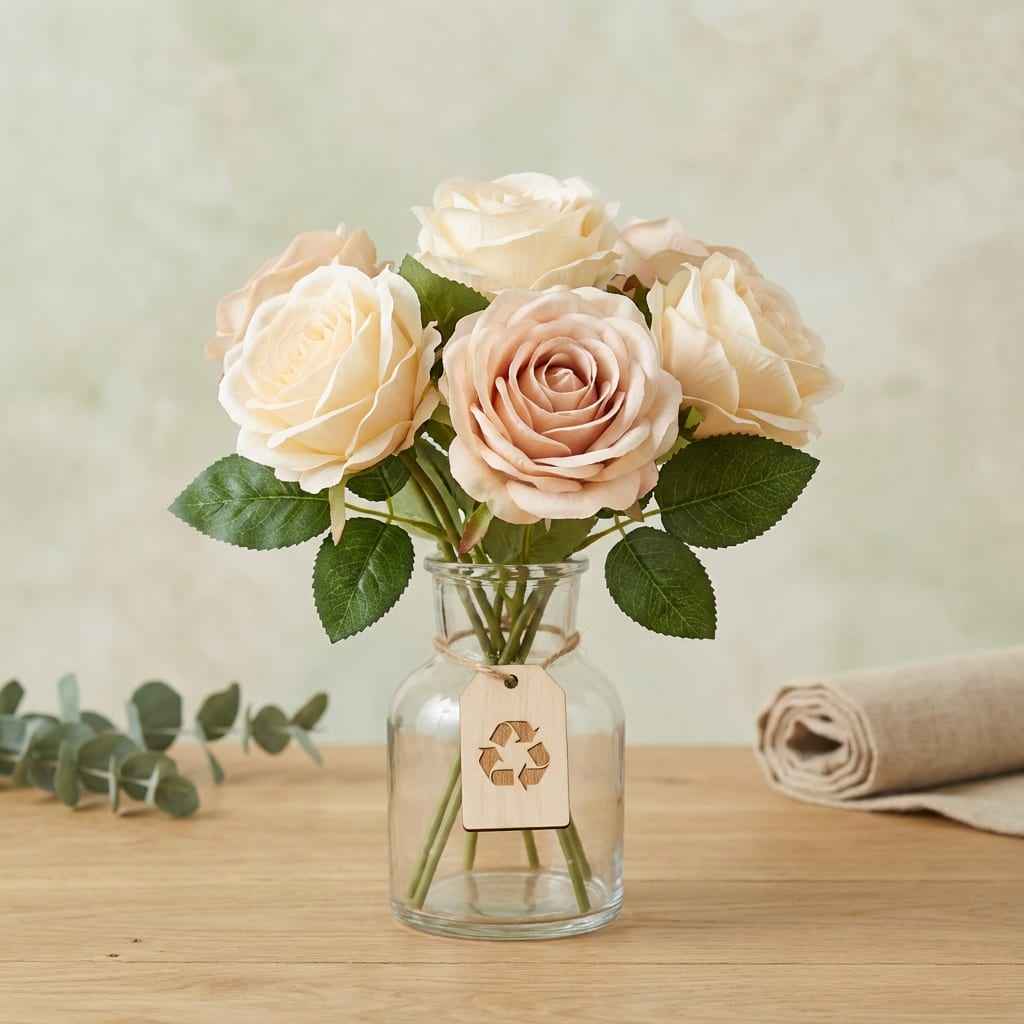
The Sustainability Question: Are Artificial Flowers Eco-Friendly?
For wholesale buyers increasingly fielding sustainability questions from customers, understanding the environmental profile of artificial flowers requires nuanced consideration. Neither artificial nor fresh cut flowers offer a perfect solution—but informed buyers can make choices that align with their values and market positioning.
This guide examines sustainability factors relevant to B2B wholesale buyers sourcing from manufacturers.
Key Takeaways
- Durability is artificial flowers’ primary sustainability advantage
- One quality artificial arrangement can replace 50+ fresh equivalents
- Material choices impact both quality and environmental footprint
- Manufacturing efficiency reduces waste through batch production
- End-of-life considerations remain an industry challenge
- Premium quality extends service life, improving total environmental impact
Fresh vs. Artificial: A Sustainability Comparison
Fresh Cut Flowers
Environmental Considerations:
- Agricultural water and land use
- Pesticide and fertilizer inputs
- Refrigeration throughout supply chain
- Air freight carbon footprint (major factor)
- Short lifespan (days to 2 weeks)
- Frequent replacement required
Quality Artificial Flowers
Environmental Considerations:
- Manufacturing energy and materials
- Sea freight transportation (lower carbon than air)
- Extended service life (often 3–10+ years in protected conditions)
- No refrigeration needed
- No water consumption in use
- End-of-life disposal considerations
The Critical Variable: Service Life
The sustainability equation heavily favors artificial flowers when:
- Quality is sufficient for extended use (often 3+ years)
- Replacement frequency is minimal
- Products are maintained and reused rather than discarded
Poor-quality artificial flowers that fail quickly undermine this advantage completely.
Material Sustainability Considerations
Latex and PU Coatings
Current Reality:
- Petroleum-derived materials
- Manufacturing process has environmental footprint
- Durability extends useful life significantly
Industry Direction:
- Bio-based alternatives in development
- Recycled content exploration
- Process efficiency improvements
Base Fabrics and Foams
Polyester Fabrics:
- Durable and long-lasting
- Recycled polyester options emerging
- Color fastness reduces replacement
Foam Cores:
- Provide structure and durability
- Light weight reduces shipping impact
- End-of-life recycling challenging
Wire and Structural Elements
Metal Components:
- Recyclable in principle
- Durable structural foundation
- Minimal in total product weight
Manufacturing Sustainability Practices
Batch Production Efficiency
Manufacturing in quantity reduces waste:
- Material cutting optimization
- Energy efficiency at scale
- Quality control reduces defects
Facility Improvements
Progressive manufacturers invest in:
- Energy-efficient equipment
- Water recycling in processing
- Waste reduction and sorting
- Cleaner production approaches
Certifications and Audits
Documents that may indicate commitment (varies by facility):
- Environmental management audits (e.g., ISO 14001)
- Social compliance audits (e.g., BSCI)
- Factory-specific sustainability initiatives
Note: Certifications typically apply to manufacturing facilities and availability varies by supplier.
How Wholesale Buyers Can Make Sustainable Choices
1. Prioritize Quality Over Price
Sustainability hierarchy for artificial flowers:
Most Sustainable: Premium products with 5–10 year service life in protected conditions
Moderate: Mid-range products with 3–5 year service life in typical indoor use
Least Sustainable: Cheap products requiring frequent replacement
2. Select Durable Materials
For applications with heavy use:
- PU finishes outlast latex
- Quality construction extends life
- Sample testing reveals durability differences
3. Plan for Product Longevity
Buyer practices that extend service life:
- Proper storage and handling
- Cleaning and maintenance protocols
- Rotation strategies for even wear
4. Consider Market Positioning
For sustainability-conscious end customers:
- Communicate durability advantage clearly
- Highlight reduced waste vs. fresh alternatives
- Position as long-term value investment
Communicating Sustainability to Your Customers
Honest Positioning
Avoid greenwashing; focus on accurate claims:
Accurate: “Reusable alternative to single-use fresh flowers” “Multi-year service life reduces total waste” “No water consumption or refrigeration required”
Avoid: “Eco-friendly” without substantiation “Sustainable” as marketing term only “Green” claims without specific basis
Total Cost of Ownership
Help customers understand the math:
- One quality artificial arrangement vs. weekly fresh deliveries
- Multi-year amortization of initial investment
- Reduced labor and disposal costs
End-of-Life Considerations
Current Challenges
Artificial flowers present disposal challenges:
- Mixed materials complicate recycling
- No widespread recycling infrastructure
- Landfill destination for most discarded products
Buyer Mitigation Strategies
- Maximize service life through quality selection
- Donate usable products when retiring inventory
- Separate metal components for recycling
- Advocate for industry solutions through supplier relationships
Industry Development
Emerging approaches under development:
- Modular designs for component replacement
- More recyclable material formulations
- Take-back program exploration
B2B CTA: Discuss Sustainability Requirements
Sustainability matters to your customers? Let’s talk about our practices.
- Contact us — Discuss quality and durability options
- Request samples — Evaluate longevity in person
- About our capabilities — Learn about our production management process
- WhatsApp — Quick questions
Trade Terms:
- MOQ: 500–576 pcs/style (quality products justify volume)
- Samples: ~15 days
- Bulk: 60–90 days
- FOB Xiamen | Sea freight (lower carbon than air)
- 1,000㎡ showroom in Xiamen
Frequently Asked Questions
Are artificial flowers recyclable?
Mixed materials make recycling challenging. Metal components can be separated; fabric and foam elements currently lack widespread recycling options.
How do I know if products will last?
Sample evaluation is essential. Test durability, construction quality, and material resilience. Premium products justify higher prices through extended life.
Do you have environmental certifications?
Some partner factories may hold environmental certifications such as ISO 14001. Documentation availability varies by facility and can be discussed during sourcing.
How does shipping compare environmentally?
Sea freight (our standard) has significantly lower carbon footprint than air freight used for fresh flower transport. Bulk shipping further improves efficiency.
What about bio-based materials?
Industry development is ongoing. Current commercial products primarily use conventional materials; bio-alternatives are emerging but not yet mainstream.
How can I market sustainability to my customers?
Focus on durability and reuse versus single-use alternatives. Avoid vague “green” claims; specific, substantiated benefits resonate better.
Suggested Internal Links
- Quality Standards
- Material Guide
- Commercial Applications
- Real Touch Flowers Wholesale
- About Our Capabilities
- Submit wholesale RFQ
Everbloom Florals is a dedicated B2B manufacturer and wholesaler of artificial flowers based in Xiamen, China. We operate as a factory-direct partner serving global wholesale buyers, retailers, and project clients. We do not operate retail florist services.
Ready to Source Real Touch Flowers?
MOQ 500–576 pcs/style · Samples ~15 days · Bulk 60–90 days · FOB Xiamen · Sea freight (FCL/LCL)
Wholesale sourcing pages mentioned in this guide
Real Touch flowers wholesale
Latex-coated artificial flowers for importers, distributors, wedding suppliers, and premium retail programs.
Silk flowers wholesale
Classic artificial silk flowers for cost-sensitive retail, event, and floral supply programs.
Wholesale artificial flower catalog
Browse wholesale artificial flower SKUs with MOQ guidance, samples around ~15 days, and FOB Xiamen terms.
Wholesale buyer MOQ guide
Plan sample requests, mixed-SKU orders, lead times, and quote details before placing a bulk order.